Speed
Speed is the distance travelled by an object in unit of time:
Distance in meter (m). Time in second (s).
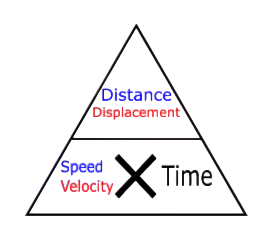
Speed and distance are scalar quantitiesVelocity and displacement are vector quantities. Speed and velocity are measured in metres m. Time is measured in seconds s.
Velocity
Velocity is defined as the speed of an object in a given direction.
Velocity is a vector quantity because it consists of a magnitude which is the speed and a direction which is the direction in which the object is moving. And so two objects moving at 20 m/s. One is moving up and the other is down, will have the same speed, but different velocities and usually in this case we use +, – when representing velocities. Speed is always positive.
Average speed
In real life, speed usually varies as the object moves. Think of a car on a road. The speed changes as road conditions change.. Highway, Traffic jam, …
Using average speed is very useful in this situation “When the speed isn’t constant” Average speed is defined as the total distance travelled divided by the total time taken.
Acceleration
Acceleration is the rate of change of velocity per unit time.
Acceleration is very important because it tells us how fast an object is speeding up or slowing down. For example Car x can go from 0 to 100km/hr in 10 seconds. That’s a 10km/h increase in speed every second.
v is the final velocity measured in m/s
u is the initial velocity measured in m/s
a is acceleration and it’s measured in m/s²
t is the time taken for this change in velocity to happen measured in seconds s
Distance-time graphs
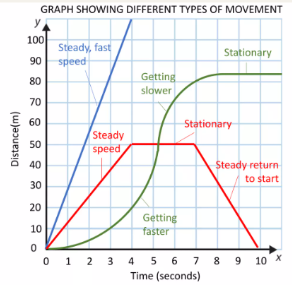
Consider a moving object starts its motion from point o and throughout its journey to the end point it slows down, speeds up, stops, moves at a constant speed and even goes backwards. we can represent all these conditions using distance- time graphs.
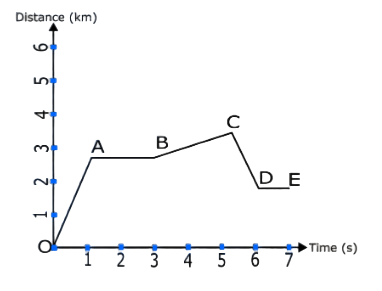
The gradient or slope is
OA the object moved almost 3 km away in about 1 hr This is also constant velocity.
AB the object is still about 3 km away, 2 hours passed from 1- 3 which means it’s at rest.
BC it starts moving again. However with a smaller gradient which means a smaller speed than OA. CD the distance from C is decreasing so it’s going backward.
A curve means a changing speed (Acceleration or Deceleration)
Distance-time graphs
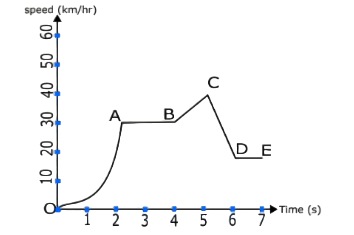
The gradient or slope is . Area under the graph is distance travelled .. doesn’t work here though because (Km/h must be converted to m/s) The curve OA means the acceleration itself is increasing.
AB means the speed is constant at 30km/hr for 2s BC is a constant acceleration The speed decreases from C to D which means this is a constant deceleration. DE constant velocity.
Distance-time graphs
Free Fall:
Free fall is when an object moves under the force of gravity alone.
An object located within the Earth’s gravitational field will experience a force which is gravity force or weight in this case.
If the object is dropped at a certain height, it’s easy to assume that it’s velocity will keep increasing at a 9.8m/s every second rate. This could work for a few seconds though (as an approximation) because as velocity increases, air resistance increases too (A force counteracting weight) to a value so significant that we can no longer ignore causing the resultant downward force to decrease until air resistance is equal to weight force and the resultant force is zero which means acceleration and hence a terminal velocity is reached. The velocity doesn’t increase for the rest of the free fall journey.
True free fall is when an object moves under the force of gravity alone.
The acceleration is
This value is constant near the earth’s surface.
The force a 1 kg mass experiences when being in Earth’s gravitational field is referred to as gravitational field strength. In this case it’s the weight. devided by mass which gives us . g is the gravitational field strength. Measured in
This value is considered constant in a uniform gravitational field (near Earth’s surface) and all objects accelerate at if air resistance ignored. However, in reality, air resistance increases as velocity increases causing the acceleration to decrease until it’s zero. (air resistance = weight)
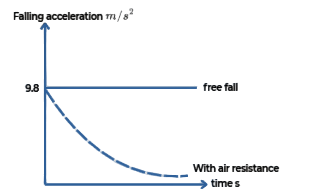
In free fall, the velocity increases at a constant rate 9.8m/s every second. Air resistance causes velocity to reach a terminal velocity where it can no longer increase.
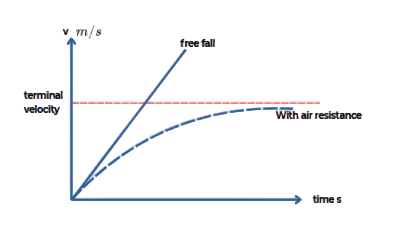
In free fall, air resistance causes the object to take more time to cover the same distance than the free fall.
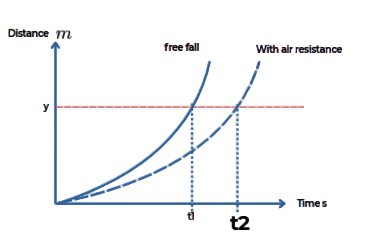
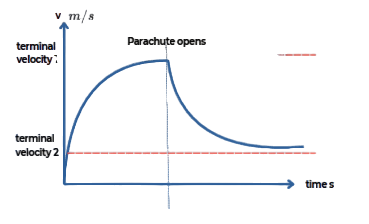
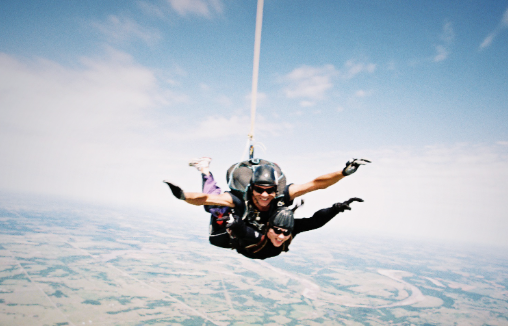
One thing that controls the value of the terminal speed is the shape of the object “Aerodynamics” So, what if the shape changes when the object is falling. Take parachuting for example. The parachuter has a high terminal velocity but when the parachute opens air resistance or drag increases causing a deceleration which causes the terminal velocity to decrease to a smaller value.